Disclosure: RESHOEVN8R is a Kick Supply ambassador partner and we earn a commission on purchases made with our code. Some links on our picks page may also earn Kick Supply a commission at no extra cost to you.
A crease is a fold the upper makes where it bends — and it bends because your foot does. Nike puts it plainly in its care guide: all shoes are probably going to crease at some point, because the natural movement of your foot bends the shoe, and a shoe that did not move with your foot would be uncomfortable to wear. Leather, canvas and suede are all at risk, in Nike’s words. So this guide is not a promise of a crease-free life, and it is not an ironing tutorial. It is the prevention side, split the way the problem actually splits: what happens while you are wearing the shoe, and what happens between wears. The goal is to care for your sneakers — not to change how you walk to preserve them.
How this guide was built: the prevention and material guidance follows Nike’s published shoe-care guide, and every product price and product description below was checked on the maker’s own store on November 10, 2026. This is a source-based guide, not a hands-on test — we compare what each maker says its tool is for, and we do not rank one protector against another.
Start here: which problem do you have?
Worried about new creases while you wear a pair? Read the fit and protector sections — that is where new folds form. Worried about a pair losing its shape in the closet? Read the between-wears section — support is a storage job, not a walking job. Already looking at deep creases? Read the limits section before you reach for any fix: prevention tools do not rewind wear, and the most popular removal method is also the riskiest one, per Nike.
While you wear them: fit first, accessories second
Fit is the one lever that needs no purchase. Nike’s prevention advice starts with shoes that fit properly, because shoes that are too big crease more — there is extra space between the foot and the shoe, so the upper has more room to fold. The practical version: buy the size that fits your foot, not a size up or down chosen to game creasing. A protector takes up room inside the toe box, which is a fit question to solve by trying the combination on — not a reason to change the size of shoe you buy.
Crease protectors are the optional second step. A protector is an insert designed to sit inside the toe box while you wear the shoe, so the upper has support as it flexes — that is the job both brands below describe for their inserts. The two formats are the honest spread of what is sold: soft foam that sticks in place, and a flexible shaped shield. Treat a protector as a shape-support tool with a comfort condition attached: if an insert presses on your toes, squeezes the fit, or makes a pair uncomfortable to walk in, take it out. A preserved toe box is not worth a miserable wear.
The tools, with prices checked November 10, 2026
| Tool | Price | Format | Job it does |
|---|---|---|---|
| Forcefield Crease Preventer | $9.99 | Soft foam insert, two adhesive strips per preventer | Worn in the toe box, in wear or in storage |
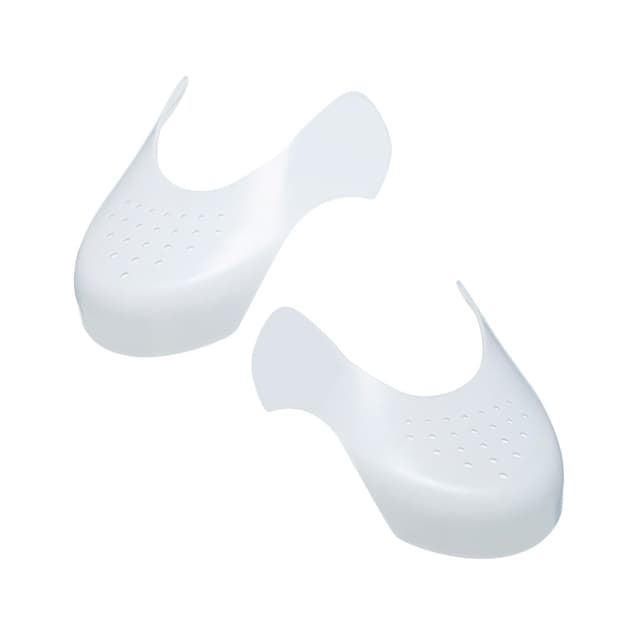
| RESHOEVN8R Shoe Crease Protector | $16.88 | Flexible perforated shield, one pair | Worn on foot or left in during storage |
| RESHOEVN8R Adjustable Shoe Trees | $17.88 | Adjustable trees, two pairs | Shape support between wears |
Forcefield Crease Preventer — $9.99 on Forcefield’s store, checked November 10, 2026. Soft foam inserts for the toe box, offered in Small, Medium and Large. Each preventer carries two adhesive strips on top: you identify the right and left inserts, remove the tape backing, slide the insert in rounded side first, and press up so it sticks to the top of the shoe. The brand describes the inserts as preventing creasing in storage or during wear, and designs them to stay in place during movement. Know the limit before you buy: the product page offers the three sizes without a readable size-to-shoe-size chart, so confirm sizing with the brand before ordering.
TOOL 01 / THE SHAPED SHIELD
RESHOEVN8R Shoe Crease Protector
$16.88 · U.S. price on RESHOEVN8R’s store · checked November 10, 2026
A pair of breathable, flexible shields shaped for the toe box, which the brand describes as holding the shoe’s shape while on foot or in storage. One honest availability note from our check: only the Large, for U.S. men’s sizes 12.5–14, was offered on the page on November 10 — the Small (6–9) and Medium (9.5–12) were shown struck through, so check your size before counting on this one. RESHOEVN8R’s own tip on the page is to order a half size up to make room for protectors; our advice is narrower — try protectors in the size you already wear well, and stop if the fit turns uncomfortable. Full disclosure: RESHOEVN8R is our ambassador partner, which is exactly why this entry sticks to what the page says.
Find buying links on our picks page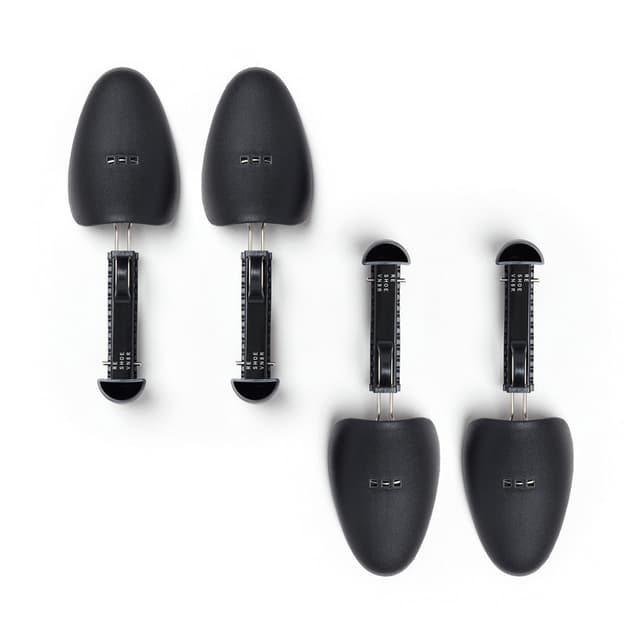
TOOL 02 / BETWEEN WEARS
RESHOEVN8R Adjustable Shoe Trees
$17.88 · Two pairs, U.S. price on RESHOEVN8R’s store · checked November 10, 2026
Two pairs of adjustable trees — a second variant on the same page lists at $19.88. The brand describes them as holding the shoe’s shape in storage and during a machine-wash deep clean, and as helping reshape shoes. That is the right frame for any tree: it supports the shape a pair already has while it rests. It is not a reset button for creases a pair earned over months of wear, and it does its job in the closet, not on your foot. Our picks page also carries cedar shoe trees through our Amazon links, if you prefer wood — Nike notes cedar trees pull double duty on odor as well as shape.
Find buying links on our picks pageBetween wears: support, not a reset button
The cheapest support is already in the box your shoes came in. In Nike’s guide, stuffing is part of its crease-removal methods: pack the shoe from heel to toe box — newspaper is its first choice, with cardboard or socks as backups — so the shoe maintains its shape. The same support is the natural storage habit: a pair put away filled rests in its shape instead of sitting empty. For a reusable version of that support, Nike describes the shoe tree: using a tree on its own is its super-simple strategy, stretching the shoe back toward its natural shape over time. Two things to get right either way. First, make support part of putting a pair away, not a rescue you remember weeks later. Second, support means filled, not forced — the goal is a toe box held at its natural shape, not one stretched tight.
Rotation is the other between-wears lever, stated honestly: wearing the same pair every day concentrates all of your steps — and all of the flexing that comes with them — in one upper. Rotating pairs spreads the same steps across your rotation instead. It does not make any single wear gentler; it gives each pair rest days with its support in, instead of back-to-back days of bending.
Check the material before the method
The prevention steps above are about shape, not chemistry — fit and support do not depend on a cleaning product. The limits, though, are material-specific. Nike’s guide is a removal guide, and its warnings are the ones worth borrowing here: Nike says its ironing tactic works best on leather shoes, water and suede are not an ideal combination, and heat can dry leather out, which is why Nike follows heat with conditioner. The prevention translation: a method that is merely risky on a leather toe box can be the wrong tool entirely on suede, and no protector or tree changes that. When a pair does need an actual clean, match the kit to the material first — that is the whole argument of our best sneaker cleaning kits guide — and keep the rotation you are protecting in shape with the pairs in guides like our best sneakers under $100.
What not to do
Do not treat this as an ironing tutorial. Nike publishes buffered ironing instructions in its guide, and in the same guide calls ironing the riskiest removal method it lists: a hot iron put directly on a shoe can irreparably damage it, and Nike’s ironing method itself needs both a cloth buffer and a stuffed shoe. A prevention guide’s honest position is that heat is a last resort for creases that already exist — not a routine, and never a first move on a new pair.
Do not buy the wrong size to fight creases. Too-big shoes crease more, per Nike, and an uncomfortable protector setup gets taken out and never used. Do not overstuff. Support holds a natural shape; forcing a toe box wider than your foot is a different job, done with different tools, and it is not crease prevention. And do not chase a fold-free walk — changing how you step to spare a toe box trades your comfort for a cosmetic result no method here can guarantee anyway.
THE QUICK ANSWERS
Sneaker creasing FAQ
Can you stop sneakers from creasing completely?
No. Nike’s care guide states that all shoes are probably going to crease at some point, because the natural movement of your foot bends the shoe. Prevention — fit, an optional toe-box protector, and support between wears — is about supporting the toe box while a pair is worn and rested, not eliminating creases.
Do crease protectors work?
They are designed to support the toe box’s shape from inside while you wear the shoe — that is the intended function both products above are sold for: the Forcefield foam insert at $9.99 and the RESHOEVN8R flexible shield at $16.88, prices checked November 10, 2026. We do not claim a percentage of creases prevented — no such figure is ours to give. If a protector makes the fit uncomfortable, remove it.
Do shoe trees prevent creases?
Trees work between wears, not during them: they hold the shoe’s shape in storage, and Nike describes a tree on its own as slowly stretching a shoe back toward its natural shape. The RESHOEVN8R adjustable trees in this guide are $17.88 for two pairs, checked November 10, 2026. A tree supports the shape a pair has; it is not a reset button for deep, set-in creases.
Does sizing up or down stop creasing?
No — buy the size that fits. Nike’s guide says shoes that are too big crease more because of the extra space between foot and shoe. One brand, RESHOEVN8R, suggests ordering a half size up to make room for its protectors; that is the brand’s fit tip for its own insert, not a general sizing rule.
Should I iron creases out of my sneakers?
Treat heat as a last resort, not a routine. Nike publishes an ironing method with a damp cloth as a buffer, and in the same guide calls ironing its riskiest method and warns that a hot iron directly on a shoe can irreparably damage it. This guide covers prevention; if you try any heat method, follow the shoe maker’s guidance for that material first.
YOUR TURN